 Skip to content

Or, We Don’t Know Everything—We Just Remember Lots of What We Like
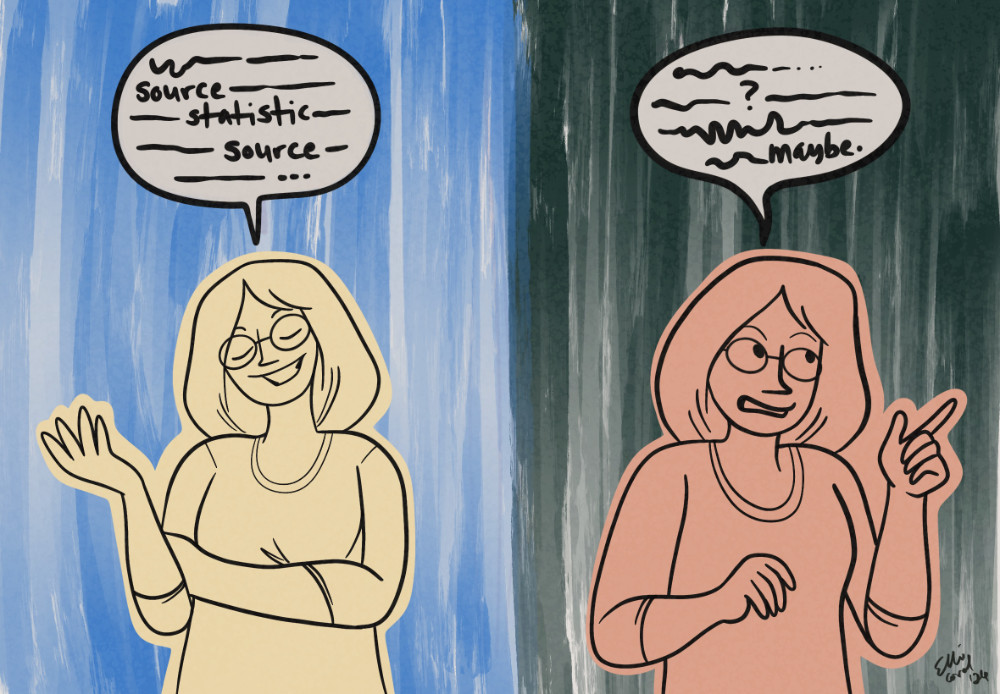
For the casual observer, you might assume that researchers are naturally gifted orators who can give insightful speeches at the drop of a hat. Give us a podium, a microphone, and a bespectacled, cardigan-swathed audience, and we’re in our natural element.
Now ask us to speak about something we’re not familiar with. Or an article we read earlier that day. Or something we read as undergraduates.
We’d probably stammer, pause, and search the air as though the answers were hovering just above our heads. The more confident folks may say, “I’m not familiar with that. Tell me more.” The more desperate among us might stare like a deer caught in the headlights or fling ourselves through the nearest plate-glass window, even with our complete lack of generous healthcare benefits.
The truth is that we’re not terribly chatty about things we don’t know. In fact, you’d probably find that researchers are a lot like everyday folks who just happen to specialize in certain topics.
That’s part of why academics sound so smart. They research. They read a lot. And, perhaps most importantly, they tend to read many of the same materials.
It isn’t unusual to hear a conversation like this:
Researcher 1: There’s been a study about repetitive technoskeletal trauma.
Researcher 2: I did read about that recently. In fact, Gregory Smithson had an article in Workers Hellscape Quarterly.
Researcher 1: I think I know the one you’re talking about.
Researcher 2: I’ll send you the link.
Or even:
Researcher 1: There’s been a study on… it has to do with technologically-induced repetitive movements causing trauma to the body… *trails off*
Researcher 2: I heard about that. Someone wrote about it not too long ago. Jeremy… no, Greg… Smithson? Oh, it was a business journal. I think it’s in my search history.
Researcher 1: Workers Hellscape Quarterly?
Researcher 2: Yes! That’s the one! I’ll look it up and send you the link.
(By the way, technoskeletal isn’t a real term. But don’t be surprised if you hear something similar to it sometime in the coming decades.)
Even researchers don’t necessarily remember full titles, publication dates, or every key detail. It’s almost as though we’re human beings with brains susceptible to forgetfulness, fatigue, and strain like normal mortals or something.
Repetition is key.
I can rattle off the key details of Fobazi Ettarh’s landmark article, Vocational Awe and Librarianship: The Lies We Tell Ourselves (2018), and give you general insights into the journal where it was published without much difficulty. It was the foundation of an offshoot of my own research in which I collected information about burnout in the library profession and briefly explored how play might be used to mitigate it. (I may share some of that work here in the future.)
Ettarh’s article was one of the few I encountered early in my MLIS program, and it was such a profound piece that it has stayed with me ever since. Even then, I find myself having to reread it and refresh my memory because more interests have taken up residence in my grey matter. That’s what I get for taking up drawing animatics as a hobby again.
That said, as much as I respect her work, I couldn’t name her other articles off the top of my head. Halfway through my MLIS program, I’ve decided that librarianship isn’t a field I want to study or participate in too deeply, if I can help it. However, I may read Ettarh’s other pieces simply because I appreciate her candor and willingness to call out persistent issues within the library field—and, for that matter, in many other fields. It’s a shame that we lost her so soon; it feels as though her best work had only just begun (ACRLog, 2026).
That’s another important part of research: what we remember tends to reflect what we’re interested in. That little spark that makes waking up in the morning a joy instead of a chore, because there’s an adventure of searching and discovering ahead of us. The little rabbit of curiosity that dares us to chase it through the thicket and into the warren, where persistent hounds may eventually have to drag us out lest we forget to do the laundry, go to the post office, or even make dinner for ourselves.
Over time, my own research path may change. I might remain close to academia and focus on helping graduate students. I might focus more strictly on play culture. I could specialize in workplace well-being or game preservation. I could base my research on content creators, their culture, and their well-being. I could stick with my decision to be a “jill of all trades” and research whatever catches my interest. I could even discover an entirely new field that I haven’t considered yet.
Honestly, there are many paths diverging from where I am now. But wherever I end up, I’ll probably be able to cite the sources that matter to me as though I’ve read them several times before—because I probably have.
So if you ever feel a little bit dumb standing next to someone who seems to know everything—someone who can casually name an obscure researcher, identify a journal, and pull up a link before you’ve even finished explaining what you’re looking for—remember that you’re probably witnessing repetition, not omniscience.
Trust me. They have their moments, too.
Reference
ACRLog. (2026, March 4). Tribute post for Fobazi Ettarh. https://acrlog.org/2026/03/04/tribute-post-for-fobazi-ettarh/
Ettarh, F. (2018, January 10). Vocational awe and librarianship: The lies we tell ourselves. In the Library with the Lead Pipe. https://www.inthelibrarywiththeleadpipe.org/2018/vocational-awe/
(Yes, that’s the publication’s name. Yes, it’s peer-reviewed. And yes, you will take it seriously despite the name.)