 Skip to content

Or the Problem of Talking Only to Ourselves
I’m currently taking an art practice research course during what is my final semester of graduate school. There’s something bittersweet about that. On one hand, I’m glad to finally be unleashed upon an unsuspecting world (student loans are another matter entirely). On the other hand, courses like this remind me why higher education can be worthwhile in the first place, and why it seems all the best stuff tends to happen toward the end.
Not because some classes are more laid-back or offer more freedom in discussion, but because of conversations like this one.
The following video I found through this course features Dr. Jarek Kriukow and Dr. Patricia Leavy in a conversation about qualitative arts-based research. Already, I can sense some wariness from you. How can this be interesting? What does this have over cat videos, Twitch VODs, or a forty-minute essay on racial tensions in Skyrim?
What if I told you that Leavy lays down some uncomfortable truths about academia and publishing—something that many insiders wish they could scream from the rooftops?
Okay, What is Arts-Based Research?
The short explanation is that it involves researchers adapting creative arts into their projects, whether for one phase of the process or the entire study. It can take many forms: visual art, poetry, narrative fiction, music, film, dance, audio… the list goes on. If it’s artsy, it can be used.
Art can serve as data collection, interpretation, analysis, or even the final presentation of the findings. One example Leavy shared involved researchers studying students’ experiences in school. Rather than relying solely on interviews, students were invited to create artwork. The artwork itself became data, supplemented by follow-up conversations.
Out of all the samples, one stood out: a student had drawn only a cropped portion of her face. When asked why, she explained that she felt “boxed in” at school. Traditional interview questions might never have uncovered this, and a deeply human experience might have been obscured by numbers.
That’s essentially arts-based research: it vocalizes what is sometimes never spoken.
The Audience Problem
One of the most interesting parts of the conversation concerns a question many graduate students and early-career researchers eventually ask about the research they’re conducting and reading: Who is all of this actually for?
Turns out, not a whole lot of people. Leavy points out that a majority of academic journal articles are scarcely read. In some disciplines, particularly education and the social sciences, many papers may only ever reach three to eight readers. Three to eight.
Considering that researchers may spend years conducting studies, writing manuscripts, revising submissions, and navigating peer review, that number is downright depressing. By the time many articles are finally published, the information may already be outdated. And in an age shaped by social media and instant communication, the delay becomes even more noticeable.
Suppose you read an article warning about the environmental costs of an emerging technology. The underlying research might have begun six years earlier. Meanwhile, engineers may have already improved the technology considerably and devised closed-loop systems to reduce water usage.
But if you’ve been online long enough, you’re aware that public discourse often reacts (intensely and emotionally) to the information that sounds most dire or threatening. All the better to posture, accuse one another, and die on hills.
Research operates on a much slower timetable than the internet. That’s bad news for people who want or need to share their findings.
The Academic Ouroboros
Leavy jokingly refers to herself as a “dirty truth teller,” and it’s a rather lovely title.
Academics usually enter their fields because they want to contribute knowledge. Yet much of academia can become strangely self-contained. Researchers publish papers that are primarily read by other researchers, who then publish papers read by still more researchers. Knowledge circulates among specialists. The system feeds itself. It becomes bloated with papers that reach very few eyes.
Some of these scholars may not do this out of maliciousness, ego, or pride (but that’s another discussion altogether). But institutions have habits, and institutions tend to preserve themselves.
Another uncomfortable truth is that many researchers read articles primarily because they need sources for their own work. I know because I’ve spent the last two and a half years reading countless articles, and if I’m being honest, I barely remember ninety percent of them. Reading something because you need at least five citations for a lengthy paper is very different from reading because you genuinely want to.
No, Really, Who Is This For?
In many of these dust-magnets of articles, you’ll find passages declaring who this information is for. Not the academics themselves, but if you thought that, you’re catching on. No, these passages are different. This is where authors are expected to explain how their work will ripple outward into the world.
It’s usually “influence policymakers,” “improve public understanding,” “contribute to something other or whatever.” Something vaguely hopeful and helpful.
The irony is that the very articles these authors claim will help outsiders are often written in academic language that assumes an academic audience.
That’s not to say that policymakers can’t understand academic language. But if we understand the current political climate, how many policymakers do you really think are eager to wade waist-deep through academic prose? Many graduate students and instructors barely want to do that themselves.
And don’t get me started on paywalls. Knowledge shouldn’t belong exclusively to people with letters after their names, but that’s how it’s been for generations.
To be fair, not every article is hidden behind paywalls. Many are open access, and some publications exist specifically to make articles available to everyone. Still, barriers remain. If not the price of admission, then the psychological aspect of justifying the payment. I can’t fathom paying $30 for a fifteen-page article when I have a hard enough time talking myself into plunking down five bucks on a clearance book at Barnes & Noble.
A More Lasting Impression
Getting back around to the core topic, one reason Leavy is drawn to arts-based research is that it forces researchers to think about audience. Her best example is her own writing, particularly her novels. They incorporate her research interests and have reached both academics and general readers. Years after publication, people still reach out to tell her how much a particular novel changed their worldview, helped them understand a spouse, or gave them insight to carry them through a struggle. That’s a very different sort of legacy than quietly becoming citation number six in someone else’s literature review.
I’ve only scratched the surface of what’s discussed in the video. If the idea of arts-based research is interesting in any way to you, take a gander and see what it might spark in you. It might even change the way you see art.
Further reading
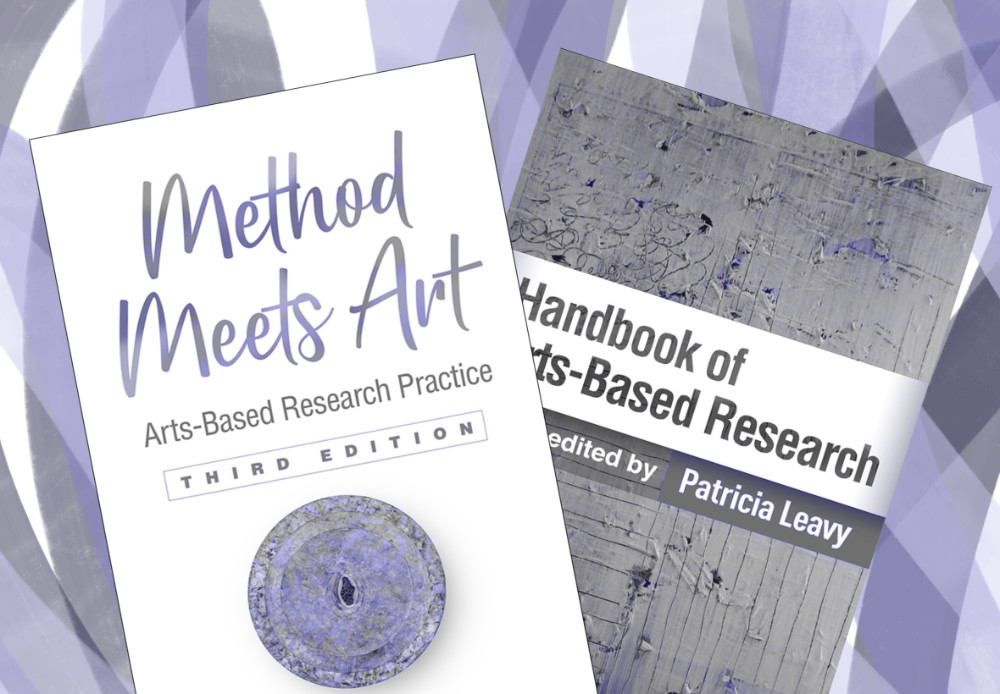
Leavy, P. (2018). Method meets art: Arts-based research practice (3rd ed.). Guilford Press.
Leavy, P. (Ed.). (2019). Handbook of arts-based research. Guilford Press.
Reference
Qualitative Researcher Dr Kriukow. (2020, September 23). Arts-based research: Definition, procedures & application (Dr Patricia Leavy) [Video]. YouTube. https://youtu.be/3rFa-wH6Gkc